
Burner spacing affects everyday gas cooktop performance by changing how evenly your pots heat and how many pans fit safely. Those few centimetres between gas cooktop burners determine how comfortably a large stockpot fits without crowding the cookware beside it.
Most people shop by brand, price and burner count, then find out at home that two large pans can’t run together. At Blue Olive, we hear that story most weeks from cooks who measured the bench but never the burners.
This guide walks you through spacing, gas cooktop size, cookware fit, and the information that helps you choose well. Let’s get into it.
Why Does Burner Spacing Change How Your Gas Cooktop Cooks?
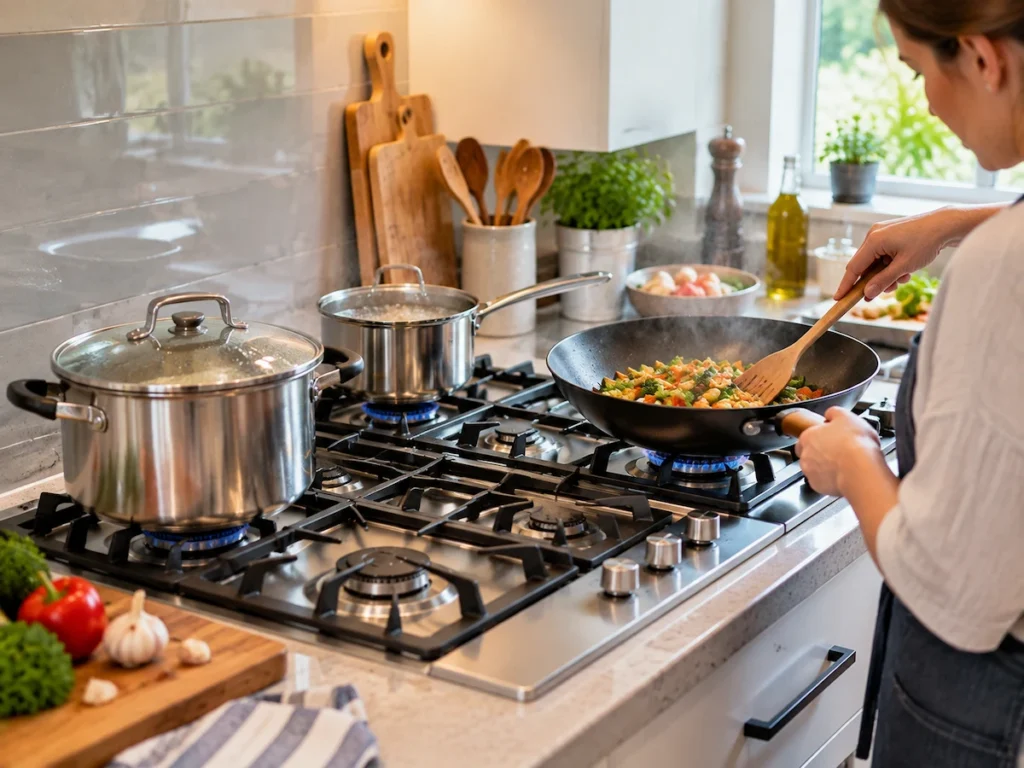
Burner spacing changes how your gas cooktop cooks by trapping heat between pots or letting pans heat separately.
For example, when burners sit too close together, neighbouring cookware can restrict airflow and concentrate heat between the pans. By comparison, wider spacing gives each flame more room to heat its pan evenly.
Specifically, three effects of spacing issues show up in everyday cooking.
- Heat Crossover: Pans parked close together bounce heat onto each other, so a gentle simmer can creep into a rolling boil while your back is turned. With wider gaps, each flame heats one base alone, which keeps a delicate sauce sitting exactly where you set it.
- Handle Clearance: Placing two large pots on neighbouring burners can leave their handles too close to an active flame. To prevent that, around 5 cm of clear space on each side helps keep handles away from direct heat and makes them easier to grip safely.
- Room to Stir: Tossing vegetables in a wok needs enough elbow room to move the pan without hitting nearby cookware. As a result, wider burner spacing gives your hands and utensils more space to move safely while cooking. It also leaves room to place a hot lid without balancing it on the trivet.
Verdict: Spacing silently sets the ceiling on what you can cook at once. That’s why you should count the centimetres between burners before judging any cooktop by its burner count alone.
Gas Cooktop Size Sets the Real Limit on Burner Layout
Most buyers choose a gas cooktop size without checking how far apart the burners really sit. Generally, width sets the spacing budget, and every extra centimetre of cutout gets shared between four or five burners.
Walk through the two common widths below, then use the measuring step that follows them.
Standard Burner Spacing on 60 cm Cooktops
A 60 cm cooktop fits four burners into roughly 520 mm of usable width, so the burner centres land about 200 mm apart. That gap suits pans up to 24 cm across without any overlap.
Because of this, two 28 cm frypans side by side get awkward fast, and their handles start competing for the same air. Customer feedback often shows that burner spacing becomes much more noticeable once people start using larger cookware together.
Using opposite burners can reduce this crowding. So place your two largest pans diagonally (e.g., on the front-left and rear-right burners) to give each one more space for its base and handle (a habit worth building on busy nights).
How Much Room Do 90 cm Cooktops Give You?
A 90 cm cooktop hands you around 300 mm more width, which spreads five burners across the same depth with much kinder gaps between them. You’ve probably felt this difference when a Sunday roast needs three pots going at once.
That extra width gives larger cookware more clearance between neighbouring burners. Many 90 cm models also place a wok burner in the centre, which leaves enough surrounding space to use a 30 cm pan and stockpot at the same time.
However, the trade-off shows up in price and cabinetry, since a wider cutout often costs you a drawer and adds to the gas connection quote.
Checking Cookware Fit and Burner Layout Before Buying
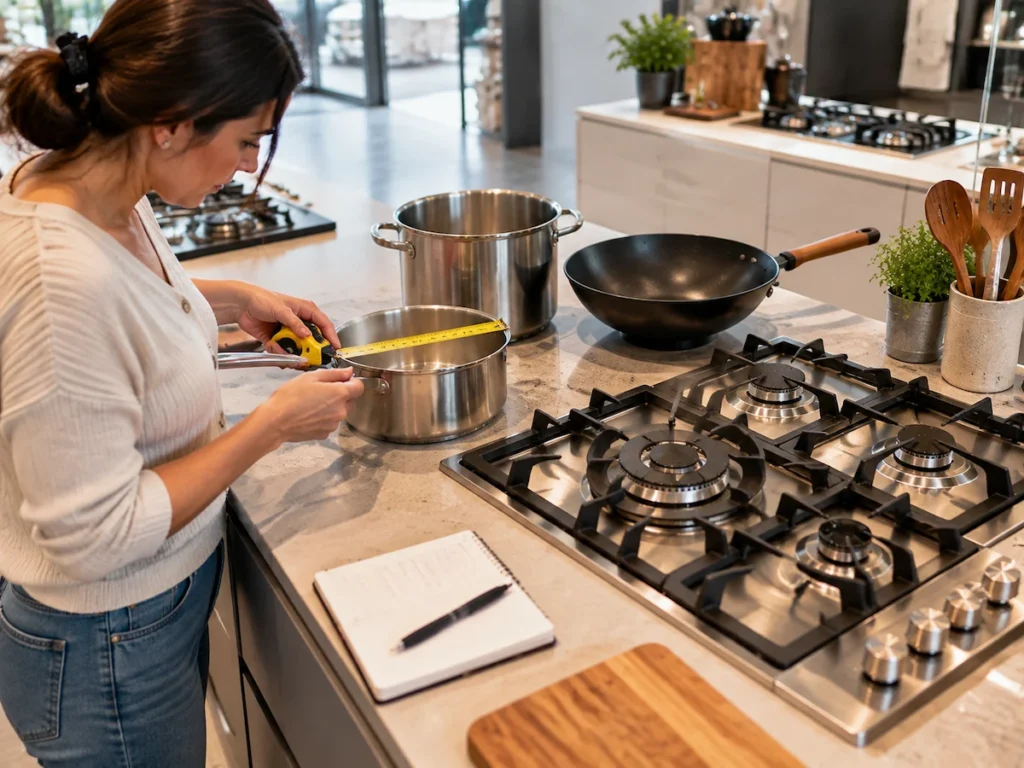
Use this cooktop buying guide to narrow your options, then measure your cookware before choosing a model. For context, manufacturer specifications give you the cooktop dimensions, but they do not show how comfortably your pans will fit together.
After that, stack your three most-used pans on the bench, measure each base, and add 4 cm of breathing room to the widest two. That figure gives you the minimum burner centre spacing worth accepting.
We’ve fitted enough cooktops across Brisbane to know that people who skip this step notice the squeeze by the second week.
Check the burner layout as well as the measurements. A large burner or wok burner needs enough clearance around its flame for wider cookware. On a five-burner gas cooktop, its position can determine how comfortably you use the surrounding burners at the same time.
The cooktop surface can affect usable space, too. A stainless steel model may have generous overall dimensions, but raised controls or wide trivets can reduce the room available for cookware. For that reason, compare the actual burner positions before deciding which model fits your usual cooking setup.
Kitchen Appliances Fit: Matching Burner Spacing to Your Cookware
Matching burner spacing to your pots means fewer scorched handles and easier stirring. Beyond width, your kitchen appliances work as a set, so the pans you already own should drive the layout you pick.
The table below pairs common cookware with the spacing that keeps it comfortable.
| Cookware Type | Base Width | Spacing Needed | Suits |
|---|---|---|---|
| Everyday frypan | 24 cm | 190 mm centres | 60 cm cooktops |
| Two large frypans | 28 cm each | 230 mm centres | 75 cm or 90 cm |
| Stockpot and lid | 26 cm | 220 mm centres | 75 cm cooktops |
| Wok on trivets | 36 cm | 280 mm centres | 90 cm cooktops |
Quick Tip: Match your two widest bases first, because those pans decide the whole layout. Everything smaller than that falls into place around them (no tape measure required twice).
Choosing Gas Cooktop Burners for Your Kitchen Appliances Lineup
Now that you know how spacing works, here’s how to choose the right cooktop burners for the way you cook.
Start with the burner mix instead of the count. A heavy-duty wok burner rated near 4 MJ needs far more clearance than three matched medium burners.
From there, look down at the trivets. Heavy-duty cast-iron trivets hold a 6 kg stockpot without flexing. Plus, its continuous set lets you slide a pan across the cooktop instead of lifting it.
Another factor is the gas type. Check if the model comes configured for natural gas or requires an LPG conversion kit. This is because different jets regulate the gas flow, which can affect burner performance.
Many brands like SMEG and Westinghouse list burner centre measurements inside the product description, so you can compare two models properly. And when a spec sheet buries that information, contact us and ask, because a two-minute phone call beats a return and a second installation price.
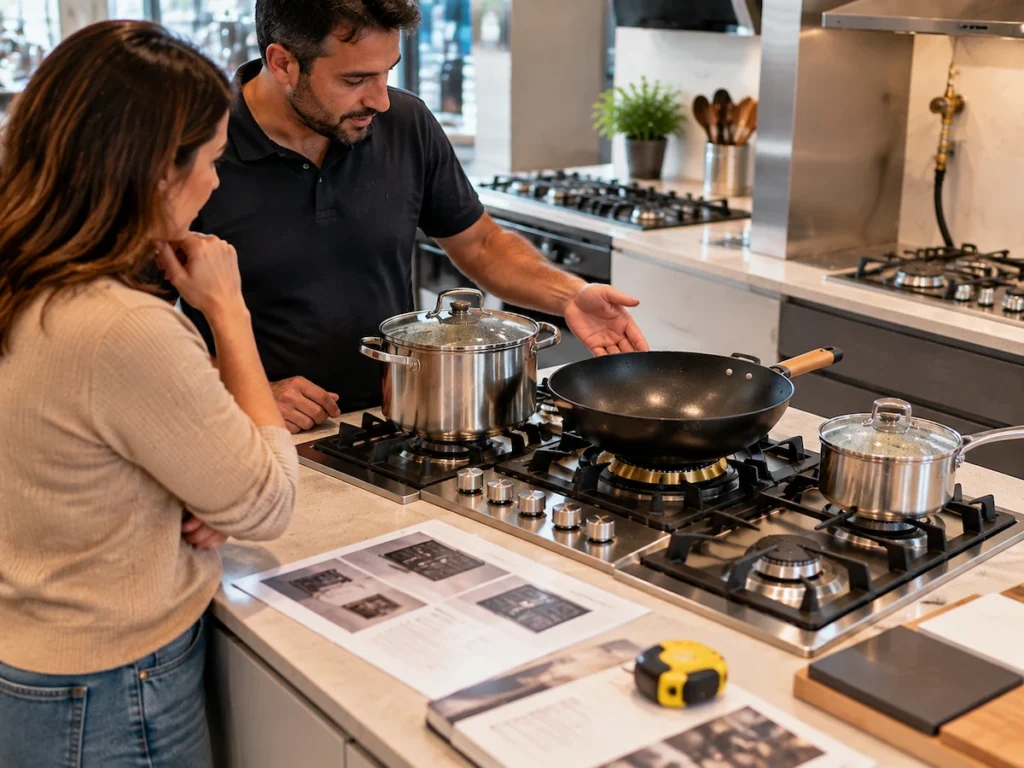
Bring Balanced Heat to Every Meal With the Right Burner Layout
Burner spacing determines how comfortably you can use several pans at once. Once you get the gaps right between different burners, every pan on the cooktop heats the way you expect.
Measure your pans this weekend, check the burner centres on your shortlist, then compare the widths that suit your bench. A tape measure now saves you months of shuffling pots later.
Blue Olive supplies gas cooktops, ovens and range hoods for homes right across Australia. Contact us to match burner spacing to your kitchen and cook with even heat every night.